
The Master of Bukhara’s Silken Dreams: An Interview with Mirzo Atamuradov

Updated: Mar 8

"In his hands, the threads of the past become the fabric of tomorrow."
In the golden haze of autumn 2025, I found myself drawn once more to the labyrinthine streets of Old Bukhara. I was not there as a mere tourist, but as a pilgrim seeking the company of a dear friend: Ergashzhon Safoevich Atamuradov, known affectionately as Mirzo. He is a hereditary master of headdresses, a devoted collector of antique textiles, and a true ambassador of Uzbek history whose soul is woven into the very fabrics he protects.

Our meeting took place within the majestic walls of the Abdulaziz Khan Madrasah, the sanctuary where Mirzo’s boutique is hidden. Built in the 17th century during the flourishing height of the Khanate, the madrasah stands as a testament to its namesake—the "brave, generous, and science-loving" Khan. Before entering, I paused to let the spirit of the city wash over me, admiring the pishtaq (portal) and the ceilings ornamented with carved stalactites. They shimmered in a palette of terracotta, lapis lazuli, turquoise, Arabian blue, and gold.
In the courtyard, I spotted Mirzo. He was deep in conversation with a group of Italian tourists, discussing the nostalgic beauty of traditional textiles as he often does with his international clientele. When he finished, we embraced with the timeless Uzbek greeting:
“Assalomu alaykum, ukham” (Peace be upon you, my younger brother).
“Va alaykum assalom, aka” (And upon you be peace, my elder brother).

Inside his boutique, the air felt heavy with memory. We spoke of his father, who had passed away only months prior—a man I had the honor of knowing during my many journeys to Bukhara. Mirzo’s path is a sacred inheritance. Despite holding two degrees in history and science, he chose to follow the footsteps of his ancestors, who were the royal creators of headdresses for the court of Mohammed Alim Khan in the 19th century.
"My grandfather and great-grandfather were artisans first, alongside their professional lives," Mirzo explained with characteristic humility. "My father began studying and collecting antique textiles in the early 2000s, devoted to them until his final days. Today, I simply continue his work."
As we spoke, the history of Central Asian embroidery came alive. Mirzo explained that while the art of textile decoration dates back to antiquity, the most iconic forms—like the Suzani¹—blossomed in the 18th and 19th centuries.


Suzani - embroidery made with silk - Origin: Boukhara - Year: 1940 © E. Atamuradov


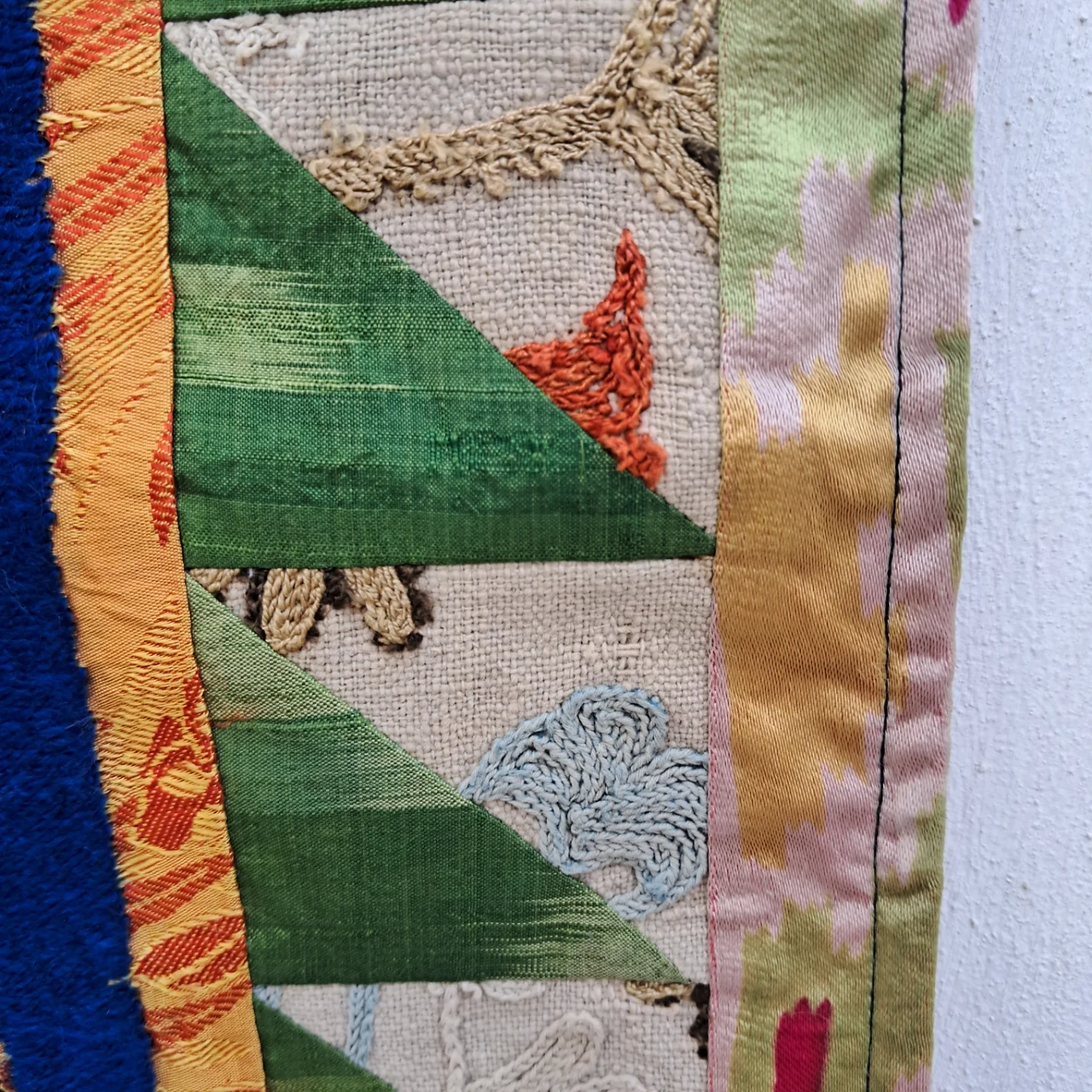
Suzani - embroidery made with silk velvet fabric - Origin: Boukhara - Year: 19th and 20th century © E. Atamuradov


Suzani - embroidery made with silk and cotton - Origin: Boukhara - Year: 1940 © E. Atamuradov
"For centuries," he continued, "Bukhara was renowned not only as a holy site but as the world's center for Zarduzlik²—the rare art of gold thread embroidery. It was a courtly luxury, unique and opulent. For a long time, the secrets of gold embroidery were guarded by men and kept from outsiders. Eventually, they taught their wives and mothers, and today, women perform this work so masterfully that Bukhara’s gold embroidery is famous worldwide."


"Kultapushak" (braided bridal headdress) - Materials: gold thread embroidery and velvet - Origin: Bukhara - People: Tajik - Period: late 19th century© E. Atamuradov
Mirzo paused to show me his collection of Kala-push³ (or duppie⁴), the traditional Uzbek skullcaps he crafts by hand. "In Bukhara, we call them Kala-push—from Kala (head) and push (to wear)," he noted. These caps are talismans; the popular Chust variety, with its white embroidery on black, often features the kalampir (pepper) or ram’s horn to protect the wearer from the evil eye. Mirzo’s own creations are remarkably soft, made from vintage silks and cottons that feel like a whisper of history.


E. Atamuradov's collection. From left to right:
1) "Kalapush" (skullcap) of a 7-8 years old child - Material: cotton - Origin: Bukhara - Year: 19th century.
2) "Kalapush" (skullcap) - Material: silk emboidery and cotton - Origin: Bukhara - Year: 19th century.
3) "Kalapush" (skullcap) - Material: gold emboidery and velvet - Year: late 19th century. © Association pour la protection du patrimoine ouzbek (APPO).
My gaze then fell upon a beautiful, ochre-colored textile resting nearby. I asked him about its origin, and he answered softly in Uzbek: "Xo’sh, bu so’zanimiz ko’rbo’z deyiladi." (Well, this embroidery is called "Ko'rbo'z⁵.")

When I asked why, he revealed a touching truth: "Because the base material is hand-woven by the blind." He explained that from the 17th to the 19th centuries, blind artisans used manual labor to weave this stiff, 25cm-wide cotton. "In Bukhara, we have had schools for the blind for a long time. This craft allows them to live a dignified and comfortable life. They are still deeply involved in our city’s weaving traditions today."


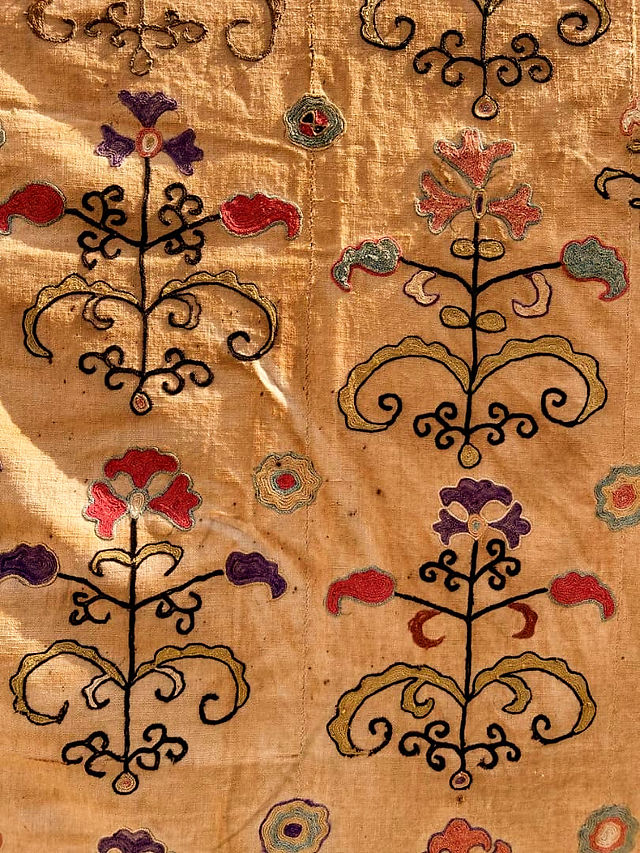


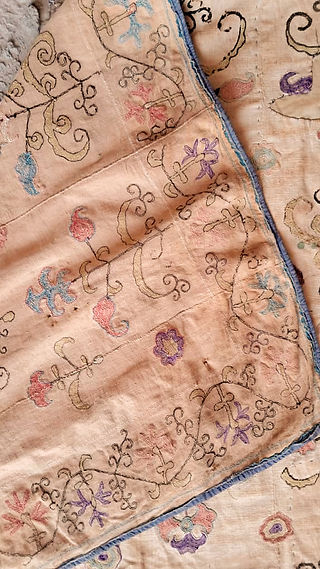


"Ko’rbo’z" (hand-woven fabric) - Material: cotton - silk embrodery with an awl - Origin: Bukhara - Year: 20th century. © E. Atamuradov
It becomes clear, watching him handle these fabrics with such reverence, that Mirzo is far more than a scholar; he is a visionary artist. By weaving his academic knowledge of history and science with the raw talent inherited from his bloodline, he breathes new life into Uzbekistan’s textile soul. His mission transcends the walls of his boutique. With a seasoned, international perspective, he has dedicated his life to a dual purpose: ensuring the whispers of his ancestors reach the ears of the next generation of Uzbek masters, while opening a window for every traveler who walks through his door to glimpse the true, shimmering heart of Bukhara.

Before leaving Mirzo’s boutique, I stopped in the madrasah’s courtyard as I always do. Looking up at the weathered corniches and the intricate tile work, a sudden flash transported me back to the 17th century. It was a moment of profound clarity—a confirmation that I had been, once more, in the presence of the true hereditary master of Bukhara.

Notes:
¹• Suzani: (From the Persian suzan, meaning "needle"). A decorative hand-embroidered textile, traditionally made of silk or cotton. A cornerstone of Uzbek heritage, the Suzani was historically created for dowries and symbolizes fertility, protection, and the strength of family bonds.²• Zarduzlik: The ancient art of gold embroidery. In Bukhara, this was once a prestigious courtly craft reserved for the robes of the Emir and his inner circle. It is characterized by the use of gold and silver threads stitched onto deep velvet.³• Kala-push: (Literally "to wear on the head"). A term used specifically in Bukhara to describe the traditional headdress. While similar to the duppie, a Bukhara Kala-push is often distinguished by its use of vintage fabrics or refined gold embroidery.⁴• Duppie (or Doppa): The traditional Uzbek skullcap, usually square or round in shape. Styles vary by region (such as Chust, Tashkent, or Fergana), with different patterns and colors indicating the wearer's origins or social status.⁵• Ko’rbo’z: A sturdy, hand-woven cotton fabric. Its historical significance in Bukhara lies in its production by blind artisans, who have preserved this tactile and precise weaving technique for centuries.
Comments